

It is Independence Day, 2024. I started this series with a single question: “What’s the deal with the appearance of direct democracy powers when our founders opposed it and rejected it?” 130 years later, our first Progressive President injected these powers into the states anyway, and we have lived with it ever since.
I started my inquiry because of the Valley’s Edge referendum, and then after encountering a civil case called Vita, in which a dissenting opinion laid out forcefully why direct democracy and land use planning are incompatible.
That led me back to the origins of this debate, which took place before our Constitution was adopted, as argued in the Federalist Papers. I pick up the investigation from there.
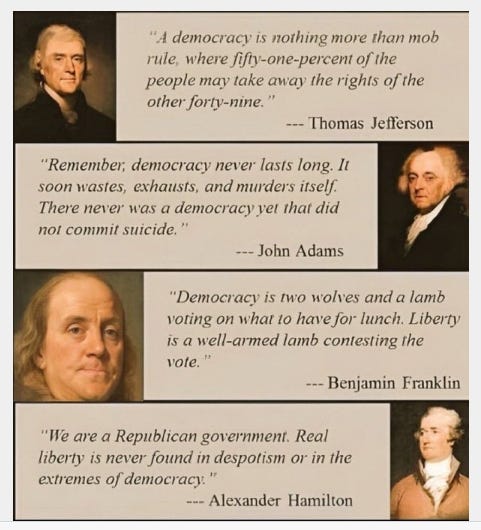
In the eloquent but archaic language of scholars 250 years ago, in Federalist #10 James Madison argued against direct democracy and elaborated on why the republican design he advocated worked to curb the negative influence of “factions.” Factions operate against the liberties of individuals, foster majority-driven tyranny, and undermine the government’s solemn duty to protect and defend these liberties, whether possessed by a majority or a minority of citizens.
A faction is
“a number of citizens, whether amounting to a majority or minority of the whole, who are united and activated by some common impulse or passion, or of interest, adverse to the rights of other citizens, or to the permanent and aggregate interests of the community.”
Put more succinctly, factions are motivated by the principles and psychology of “mob rule.”
“A faction with adequate power to mandate the actions of others will naturally strive by means both moral and immoral, to obtain what is desired, and possessed by others, money, property, or power to dictate which opinions are permitted.”
To prevent the ability of one faction to impair the liberty of others, Madison describes two possible methods: 1) remove the cause of factions, or 2) control the effects.
There are two ways to remove the cause of the formation of factions.
One way is to destroy liberty, which is essential to the existence of factions. Without the liberty to think, speak, and read freely from the library of human knowledge, factions cannot emerge or act. As long as we have the ability to exercise our liberty, we will naturally form opinions.
The other way is to give every citizen the same opinions, the same passions, and the same interests.
“As long as the reason of man continues fallible, and he is at liberty to exercise it, different opinions will be formed.”
By “fallible,” he means that reasonable people can disagree about what facts mean and how they should be understood, and therefore people will form differing or opposing opinions. As opinions encounter each other in a free society, they will be promoted and passionately defended.
“Reason becomes its object to which passion attaches themselves.”
People possess diverse and unique faculties, resulting in variations in their capacity to achieve, or even define objectives. The diversity in capacities leads to an unequal distribution of possessions, money, and property, and therefore a diversity of interests must arise. To force uniformity of opinions, orthodoxy must be promoted, and counter-narratives must be denied expression.
Censorship operates to quash information and opinions contrary to orthodoxy. State censorship protects state orthodoxy. Censorship is antithetical to liberty. Freedom of speech, religion, and property are the foundations of a free nation. Therefore, the duty of government in a free nation must be to protect these liberties and the consequences of diverse human capacities. Compelled uniformity is antithetical to freedom.
“Diversity of faculties of man is an obstacle to a uniformity of interests. The duty of government is to protect these faculties.”
The liberty to pursue diverse interests, combined with natural variations in capacity, work ethic, and luck, creates varied societal interests, practices, and outcomes. The ability to think and speak freely arises from the nature of man. Because of people’s diversity of temperament, discipline, intelligence, and interests, we are born equal, but outcomes are never equal. Speech, religion, property rights, etc. are natural rights to be protected and preserved for each individual.
Whenever different interests exist, conflicts must naturally arise. Each person is free to pursue their interests without interference, provided this pursuit does not infringe on the liberties of others. A tyranny pursued by a majority must still respect the rights of the minority. There must be a line over which no one is allowed to cross. As the saying goes, “Your freedom to swing your fist ends at my nose.”
Factions are driven by the desire to cross that line, or worse, to erase its existence. Factions place their interests above others, and as Madison argues, we cannot rely on the morality of others to judge for themselves where liberty begins or ends. For a civilized society to exist, individual and community interests must obtain and maintain balance. If that balance cannot be achieved or sustained, conflicts are resolved by power. The power to decide the rights of others is the definition of tyranny.
“Landed interest, manufacturing, mercantile, moneyed interests are necessities and an unavoidable consequence of civilization.”
A creditor’s interests are naturally different than the debtor’s, the accused and victim, or the landlord and tenant. The rights and duties of liberty must weigh on both sides equally. How shall this be done?
Mediating these competing interests is the principal task of legislation. Legislation is the general case of justice, while trials are the specific case of individuals. Legislation is the function of government, while justice is the function of courts. Legislation strives to balance competing interests in such a manner as to be best for the community as a whole while preserving the liberties of the individual and taking care not to skew towards the interests of one faction over another.
For this purpose, we established the legislative institution and the processes and procedures required for its effectiveness. Likewise, the institution of justice was developed to ensure the fair and impartial enforcement of legislative intent, constrained by our constitutional guarantees of liberty. This balance of interests is the purpose of every social institution.
Institutions, like people, are subject to capture by self-interests, yet self-interest is the foundation of liberty. This is the dilemma that all governmental systems must resolve. Deep contemplation of this dilemma points to the wisdom and intelligence of the architectural design of a Constitutional Republic.
If we apply the capacities of institutions to their intended purpose while guarding against institutional capture, we need a system of checks and balances. Not a single check or a single balance, but a system of interconnected and integrated checks and balances. The foremost among these are impartiality and transparency.
No institution can be trusted if it conducts its business in secret, and no interested party may serve as the judge of fairness in his own cause.
“No man is allowed to be judge in his own cause, because his interest would certainly bias his judgment, and not improbably, corrupt his integrity.”
In a dispute over money, we do not allow the creditor or debtor to judge the merits of the opposing party’s interests. We don’t let the accused assume the position of judge (interpreter of law) and jury (finder of fact) over his guilt or innocence. We cannot pass laws that favor the tenant over the landlord. Fairness, impartiality, and transparency are the first line of defense against institutional capture.
The nature of man inclines him to protect his interests, even if doing so is immoral. We do not rely on the morality of the accused to ensure that justice is served. Criminal guilt is proof of immorality. False accusations may entice a moral person to use immoral means to accomplish a just result. The competing interests of justice for both the victim and the accused require a carefully designed balance between competing interests.
The legislative process and the justice system are charged with reaching the proper outcome without bias for or against any party’s interest. The ideal legislative system makes a judicial (fair) determination of competing interests in a balance that is best for everyone, at least that is the presumed goal of the ideal social institution. Given certain facts and circumstances, good legislation establishes rules that equitably balance competing interests.
Direct democracy renders every social institution irrelevant and unreliable. Direct democracy allows interested parties to judge their interests against those of others, not through an elaborate deliberative process, but in a short-term emotional contest of rhetoric and resources. If one faction is in the majority, they must prevail, even if the results are not just.
“Popular government [i.e. direct democracy] enables it to sacrifice the public good and rights of other citizens.”
This is the origin of the phrase “tyranny of the majority.” Government must secure the public good, protect private rights, and preserve the spirit and form of popular government. By exercising the powers of direct democracy, the majority faction serves as the judge and jury for their interests to the detriment of the minority factions. Reason and fairness yield to power and self-interest.
If the causes of factions cannot be removed, the only remaining option is to control the effects of factions.
To control the effects of factions, there are again two methods: 1) Prevent majority factions, and; 2) prevent their ability to carry out schemes of oppression.
To prevent majority factions, it would be necessary that no majority ever feels a common passion or will. However, in any small group of people, the communication of a common passion or interest will arise, and there is
“…nothing to check on the inducements to sacrifice the weaker party or the obnoxious individual.”
“Theoretic politicians, who have patronized this species of government, have erroneously supposed that by reducing mankind to a perfect equality in their political rights, they would, at the same time, be perfectly equalized and assimilated in their possessions, their opinions, and their passions.”
To understand the best remedy for controlling the effects of factions in direct democracy, we must first distinguish the qualities of a direct democracy from that of a republic.
In a republic, the government is delegated to a small number of citizens elected by the rest. Also, the limits of their jurisdiction, local, county, state, or national, are enumerated by law. That is, a small number of delegates, compared to the number of citizens, can be empowered by both large and small-sized government bodies.
The architecture of our government delegates power differently to the local, county, state, and federal governments. Each is governed by an elected delegation with specified scopes of duties and obligations. The public view is refined, and governmental powers are enlarged at each increasing level.
In describing the benefits of a small number of delegates representing the people’s best interest, Madison says:
“…by passing them through the medium of a chosen body of citizens, whose wisdom may best discern the true interest of the country, and whose patriotism and love of justice will be least likely to sacrifice it to temporary or partial considerations.”
At the time of Madison’s writing, perhaps it was true of politicians, that people only elected those with the virtues Madison described. It is certainly consistent with the idea of virtue as an essential feature of any successfully functioning government.
Yet to show that he is not naive to the consequences of human nature, or the probability that not every elected official will have virtuous qualities, he acknowledges that the inverse is also possible.
“Men of factious tempers, of local prejudices, or of sinister designs, may, by intrigue, by corruption, or by other means, first obtain the suffrages, and then betray the interests of the people.”
To put this in more contemporary terms, politicians may lie to get elected and then act in self-interest rather than on behalf of the people. Sounds about right.
Both large and small republics are subject to political corruption. If that is the disease, what is the cure? What features of a republic must be incorporated into its design?
The first is the selection of the number of delegates. Whether the republic is large or small, it must be a sufficiently large number to “guard against the cabals of the few.” One delegate is a dictator. A council of tyrants is still a dictatorship. The number of delegates cannot be too small.
On the other hand, there must be an upper limit to that number, “to guard against the confusion of the multitude.” Too large, the delegation has all the disadvantages of popular democracy, the system a republic is designed to replace.
In our current governmental structure, as the levels of government progress from local municipalities to national government, the number of people per elected representative increases. For example, in a moderate city like Chico, CA, the population is approximately 100k people with 7 representatives, each official represents 14,000 people. In Congress, each member represents 782,000 people. Each US Senator represents 3.4 million people, and the President represents 340 million people.
As you can see, with exceptions for very large cities and counties, representation density decreases with higher levels of government, which inversely correlates with the potential influence of factions as predicted by Madison. Said another way, smaller cities are most vulnerable to the hazards of direct democracy, while national levels are least vulnerable.
By law, direct democracy powers are completely absent from our national government. States vary widely in the scope of direct voter power, and if they exist at the state level, as they do in California, cities are the most vulnerable to the issues of factions.
Even in the Presidential election, where each person votes for one president, the Electoral College system is a guard to the election of the President by popular vote. These are all features of the Constitutional Republic in opposition to the direct democracy argued for by some but rejected by the states at our founding.
The reason is simple. By structuring the government system this way, the dangers of factions would be minimized proportionally by the increasing density of representation at the highest levels of power. Direct democracy powers at any level of government were never in the plans.
As the level of government progresses from local to national, representatives are chosen by a greater number of citizens. The larger population pools and increased diversity of interests help minimize the hazards of majority factions and corrupt politicians because it is more difficult for the unworthy candidate to practice the
“vicious arts by which elections are too often carried.”
Succinctly put, the larger the pool of voters from whom delegates are selected, the more likely voters are to sniff out the snake in the grass.
James Madison launched an argument in Federalist #10 against direct democracy as a viable design for government. As he argued, the smaller the population and jurisdiction the greater the dangers of direct democracy. For the form of national government he advocated for and that we ultimately inherited, he argued for republicanism and against “popular government.” We adopted a republic, “…if you can keep it.” (Franklin)
Destroying the original design from within
The result of our founders’ debate over the proper design of our American government was that direct democracy, or “popular government” as they called it, was rejected. The issue remained settled for 130 years.
Madison and the other scholars of the time would have never imagined that the hazards of direct democracy would be injected into the republic as a parallel system of governance, and Teddy Roosevelt probably didn’t understand what he was doing when he encouraged states to ignore the founding principles and adopt the very system our founders warned against.
Since 1911 when California adopted these powers by state Constitutional Amendment, California has become the most frequent user of these powers, to the detriment of the state and the local governments most susceptible to its hazards. Here is a summary of the states that have used this power the most:
State Initiatives, Referendums, and Recalls, and Frequency of Use
California Very High
Oregon High
Colorado High
Arizona High
Nevada High
Washington High
Michigan High
These seven states represent nearly a quarter of the US population. Every day, we in California feel the effects, because the entire political apparatus has been dominated by one political ideology that embraces the virtues of direct democracy.
In California, one party dominates 65% of the state legislature and holds every statewide elected office, including the Governor. California is a prime example of the tyranny of the majority. Increasingly, the corruption of this absolute power is usurping the last vestiges of local control, including law enforcement and land use, public schools, the courts, police, and justice.
A large, centralized government monopolized by dominant party super-majority control is precisely the government design our founders rejected. Ironically this is also the justification for Teddy Roosevelt’s proposal that states adopt Direct Democracy as a cure for monopoly corruption by special interests.
For the past 113 years, we have lived with the worst of both worlds. As we might expect, the brunt of this innovation has been most painfully felt at the local levels, where the powers left to local government have been occupied increasingly by state policy and laws, and where the hazards of direct democracy powers in the hands of proportionately large factions are the greatest.
California history since 1911, when direct democracy powers and other major constitutional changes were injected into the original republican design, we see that direct democracy powers have been most often and easily exercised at the local levels of government, are more difficult and less common at the state level, (though California has been a devoted practitioner) and do not exist at all at the Federal level.
The level of government where factionalism empowered by direct democracy has its strongest effect is the very level where it is most common and where the hazards are most apparent.
The absence of direct democracy mechanisms at the federal level, for the very reasons Madison articulated, factionalism and instability, makes it all the more curious that our national leader, President Theodore Roosevelt advocated for such powers at the state and local levels, where the risks of factional dominance are arguably greater, while leaving the republican government unchanged in his domain.
The irony in Roosevelt's advocacy for direct democracy at the state and local levels, while it remains absent at the federal level, highlights a fundamental tension between progressive ideals and practical governance. Roosevelt’s support for direct democracy was driven by a desire to combat corruption and empower citizens, especially in contexts where government responsiveness was lacking, most notably in smaller and more homogenous political units where such dynamics played a more significant role.
However, this approach also introduces the risks of increased factionalism and special interest dominance at the local and state levels. The cure Roosevelt prescribed to combat corruption is absent at the federal level, as if corruption and special interests are not a problem for Washington DC.
While direct democracy can be rationalized by the progressive ideals of enhanced citizen participation and control, its application at the local level amplifies the dangers that Madison and the Framers sought to avoid. The original selection of republicanism over direct democracy has only been preserved at the federal level, demonstrating the principle that it’s nice to be King.
Factionalism and Special Interests and Direct Democracy Powers
Many claim we live in a democracy, but that is not correct. We live under a Democratic Constitutional Republic. Under this system, the levers of power must be checked and balanced against one another. Failure to maintain this balance leads to tyranny, and direct democracy is a tool of tyranny.
Three components of the checks and balance system are 1) participation; 2) representation; and 3) the rule of law. These three elements demonstrate the challenges of any system of checks and balances. If any of these dominates the others, instability and volatility result.
If participation dominates there is a risk of populism and impulsive decision-making without regard to minority rights or long-term consequences. Direct democracy emphasizes participation over other values. Informed citizen participation requires an educated electorate and accessible forums for public deliberation to facilitate well-informed decisions.
If representation dominates through excessive checks, the distance between representatives and their constituents is too great, which leads to perceived bureaucratic inefficacy and disenfranchisement of the electorate. Inclusive representation protects minority rights and prevents majoritarian excesses through judicial review and balanced policy frameworks.
If the rule of law dominates through an overly restrictive legal framework or judicial activism, the democratic process is undermined, hindering genuine participation. Upholding the rule of law means ensuring that judicial decisions comply with constitutional and legal standards while allowing room for genuine public influence.
Institutional capture and direct democracy
The abuses of direct democracy, the ineffectiveness of politicians, an unreliable justice system, the absence of a free and unbiased press, and a general mistrust of the integrity of free and fair elections, are all hallmarks of our contemporary political experience.
The traditional American values of transparency, separation of powers, the supremacy of the rule of law over the will of men, a free press and media, social civility and civic responsibility, the integrity of free and fair elections, judicial independence, anti-corruption safeguards, local autonomy community control, an informed public well versed in civic education, and checks on executive powers through legislative oversight and judicial review, all have been lost or degraded.
Among the many causes, direct democracy has been a disruptive influence and has facilitated the process of institutional and regulatory capture by factions who have accumulated power over the decades. California, with its single-party dominance and liberal use of ballot initiatives and referendums when it is convenient, is at the forefront of corrupt political power. These things also exist elsewhere, but nowhere have they matured more fully than in California.
It is bad at the state level, but even worse locally
The irony of the past 113 years of our experiment with direct democracy is that when exercised at the local level, it is more easily captured by factions and special interests due to smaller, more homogenous populations. This has had the inevitable consequence of favoring the narrow interests of factions over protecting and preserving the public good.
Local issues often provoke strong emotional responses, leading to motives driven by immediate passions rather than long-term considerations. The history of initiatives and referendums in California and its local jurisdictions demonstrates how effectively political operatives can manipulate campaigns that target the superficial passions of the voters, thus successfully placing their self-interests over the long-term interests of the people they deceive.
The unintended consequences of direct democracy have enabled oversimplified solutions to complex issues, leaving voters not fully informed about the larger implications of their decisions. Most often, those implications appear long after the votes have been cast. California’s Proposition 47 is just one example.
Direct democracy powers throw a monkey wrench into institutional effectiveness and due process. Every social institution has at its foundation careful consideration, specific expertise in the subject area, and most importantly, transparency and checks and balances. This is true of every social institution, whether criminal justice, public education, homelessness, or land use planning.
Admittedly, social institutions are subject to their own peculiar forms of corruption. Even those with the best intentions and purest motives can fail to comprehend the full scope and long-term impacts of their most important decisions. There is ample evidence that social institutions are subject to capture by special interests. But the deliberative process, where sufficient time is allotted to a publicly transparent process, allowing passions to cool and reason to prevail, is the proper mechanism for implementing the checks and balances of a republic, our uniquely American system of governance.
Referenda and voter initiatives can create administrative burdens and instability in governance, complicating effective management and planning. The more common they become, the greater their disruptive power.
What good is any planning process if it can only be undone by the whims of impetuous and uninformed popular passions? Of what value is subject matter expertise or careful planning if the resulting conclusions can be easily undone by uninformed or misled voters who, having not participated in the preceding process, are only subjected to the unrestrained misinformation and deceit of special interests who do not openly declare their motivations.
The worst of all worlds is the exercise of direct democracy powers at the local level, although state referendums have also produced some pretty bad results, as any review of California’s history of initiative demonstrates.
The worst of all worlds for Madison would be the situation he could not have imagined: a republican form of government wherein its authority and process were infected by direct democracy. The choice between republicanism and direct democracy was meant to be mutually exclusive, not some Frankenstein monster where both coexist.
We have taken the carefully argued and designed system of government and bastardized it in ways that ultimately could be its undoing. Perhaps that has been the most fundamental goal of the Progressive movement, to undo and undermine the republican design and the constraints of the Constitution.
Metaphorically, we have taken a precision Swiss timepiece and turned it into a wind chime.
And Teddy Roosevelt called himself a Republican, wow. He was a RINO!
Thanks Rob for bringing back these facts to memory, in order, of how the hell we got to this point on the left coast. Young people have little, if any, idea of these facts yet wonder how California went to hell so quick. The education system stopped requiring civics to graduate, I think that was a deceiving plan by one of the strongest Direct Democracy Factions in California, the Teacher's Union.