

“Freedom may be inherited, but liberty must be practiced.”
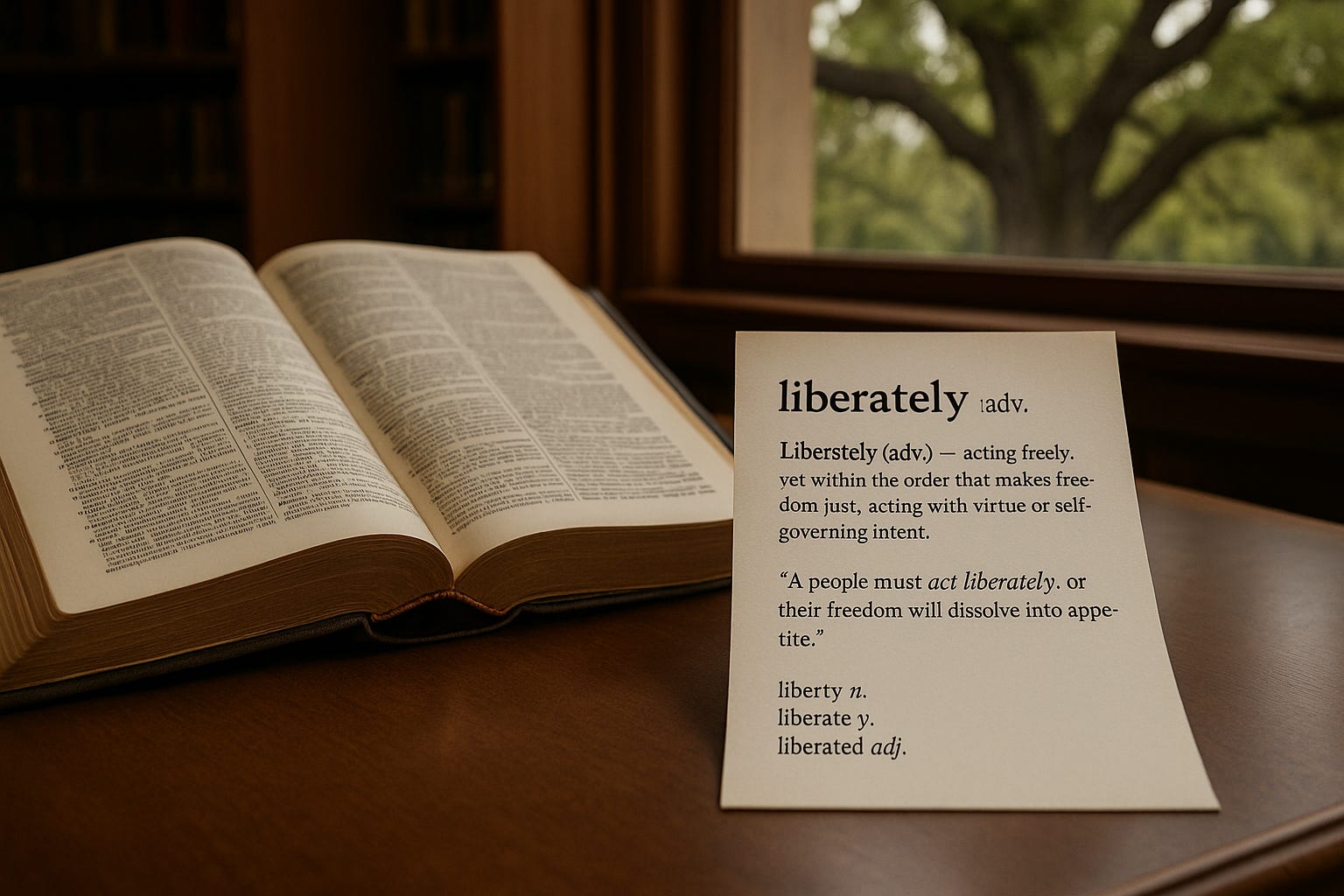
The Recovery of a Forgotten Word
I love words. Every tyranny begins with the corruption of language. From time to time, we may need to invent new ones. That is what I’m doing here.
When people forget how to name the moral dimension of their freedom, they soon forget how to defend it.
Freedom remains in our speech, but liberty has grown hollow, reduced to a legal category rather than a moral condition. To recover the living soul of liberty, we need a new word that restores its active form, a way of speaking that joins freedom with conscience and morality.
That word is liberately.
To live freely is to act without restraint.
To live liberately is to act with self-restraint, guided by moral purpose and respect for the equal freedoms of others.
Where freely describes motion without obstacle, liberately describes motion within harmony, freedom ordered by character.
Your freedom to swing your fist ends at my nose. Your liberty to swing your fist begins and ends with virtue.
The sound of the word recalls deliberately, and that echo is no accident: both share the Latin root liber, meaning “free.” To act deliberately is to act only after thinking things through; to act liberately is to act from the inner discipline that makes these thoughts fruitful to liberty.
This distinction marks the first point of contact with tyranny.
Authoritarian power rarely abolishes freedom outright. It merely redefines it until liberty becomes vague and even unnecessary. Citizens are told they are “free”: free to consume, free to repeat slogans, free to vote in elections whose outcomes are determined by the prevailing orthodoxy.
But they are not free to live liberately, not free to dissent without punishment, to educate their children according to conscience, or to organize their communities independent of state permission.
The true measure of despotism, therefore, is not how many choices remain, but how many choices may be made with integrity to the principles of liberty without outside restraint.
A state that fears liberty will always seek to criminalize liberate living. It multiplies rules where trust in local citizens once sufficed. It replaces competence with credentials, and moralizes obedience as virtue. It legislates compassion while forbidding conscience, and administers justice until justice itself becomes little more than imposing administration instead of safeguarding liberty.
In these countless small encroachments—school curricula dictated from afar, laws that punish speech but not deceit, the silent surveillance of digital life—citizens begin to feel the walls of an invisible cage. Each encounter with state-imposed obstacles, every time one realizes they cannot act liberately—freely and rightly—one brushes against the edge of that cage of tyranny.
Yet these collisions are not the end of hope; they are the beginning of awareness.
The will to live liberately—to tell the truth with respect, to obey lawful authority but not servility, to preserve integrity in the face of pressure—is the first act of civic renewal.
A society that teaches itself to act liberately gradually rebuilds the moral infrastructure of liberty. It relearns how to govern from the inside out, and resists tyranny imposed from the top down.
The Practice of Living Liberately
To live liberately is not an act of rebellion; it is an act of cultivation. A self-governing people must first learn to govern themselves and to order their daily lives by principle rather than permission. The authoritarian state thrives where citizens have forgotten how to live without its supervision.
The antidote is not defiance for its own sake, but the reawakening of conscience: the rediscovery of liberateness as a habit of life. This begins not in the halls of governments or courts, but in homes, schools, and towns, and every human heart.
Education
The state’s deepest influence begins in the classroom, where it shapes the imagination of the young. To live liberately in education means restoring the authority of parents, teachers, and local communities over what is taught and why. A liberate school teaches discernment, not dogma; reasoning, not recitation.
It does not tell students what to think, but teaches them how to think and why to care about truth.
When education becomes an instrument of ideology, liberty erodes. When it becomes a training ground for sound, moral judgment, liberty is renewed.
Speech
Speech is the bloodstream of freedom. When citizens fear speaking honestly, liberty has already begun to clot. To live liberately in speech is to speak truth with humility, to listen with respect, and to reject both censorship and rage. The liberate citizen prizes persuasion over power, and truth over orthodoxy. Despotism cannot long survive where words remain sincere and debate remains possible.
Work and Commerce
When the government dictates every license, fee, and code, productivity becomes a privilege. To live liberately in commerce is to reclaim the dignity of work from bureaucracy.
Small businesses, tradesmen, and artisans embody this principle each day, creating and exchanging without dependence on centralized permission. Communities that sustain their own economies—through honesty, skill, and voluntary exchange—practice liberty in its most tangible form.
Faith and Conscience
The right of conscience is the first liberty, not one that is granted by the state. The government can only support or oppose our right to think for ourselves. We cannot surrender our right to think.
To live liberately in faith is to uphold that moral order which sustains self-government.
When conscience bows to coercion, the soul of the republic bows with it.
A society that protects the independence of its churches, charities, schools, and town halls preserves its moral boundaries against political intrusion.
Civic Life
Self-government is not a slogan but a discipline. To live liberately in civic life is to participate in the duties that precede government: family, neighborhood, voluntary association, and speaking one’s mind.
Where these smaller sovereignties thrive, the state cannot pretend omnipotence.
A clean park, a well-run school board, a transparent town meeting, these are not trivial local acts; they are the republic in miniature.
A nation that forgets how to govern its neighborhoods will find itself governed from afar, and that time has arrived. Liberty exercised locally is barely remembered by citizens today.
The Measure of a Free People
To live liberately is to govern one’s conduct before demanding to govern the conduct of others. It is to resist both cynicism and dependence, and the belief that corruption makes virtue useless, or that comfort makes virtue optional.
Every society must choose between regulation and responsibility, and that choice is renewed or abandoned every day in the behavior of ordinary people. The liberate citizen does not wait for permission to do what is right, nor use freedom as an excuse to do what is wrong. S/he lives as if liberty were fragile, because it is.
The authoritarian state cannot extinguish such citizens; it can only exhaust them. But exhaustion yields when meaning and purpose return. People who still know how to live liberately, to speak, work, teach, and deliberate free from outside constraints carry within themselves the seed of renewal.
Laws may bind the body and propaganda may cloud the mind, but the habit of living liberately restores the soul. It is the quiet revolution of conscience, repeated daily, by which we can prove ourselves worthy of the liberty with which we are endowed.
A People’s Oath
We shall strive to not live freely, but liberately, so that our freedom does not consume itself in appetite, and our liberty does not perish for want of virtue.
Thanks Rob, a really great read! I've watched our education system fail dramatically by refusing to suggest or teach how to live a moral life. Without that, we're lost to the system with no clue how we got there or how to get out.