
Sound of Freedom
The movie, the narrative and beyond...

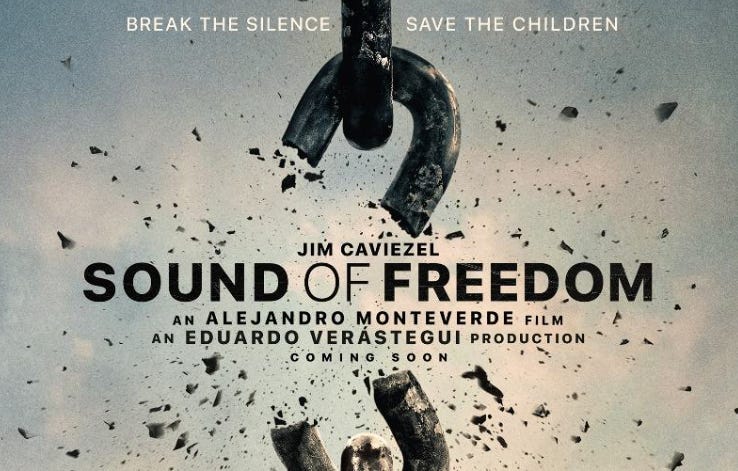
I live a block from Citrus Elementary School, and when school is in session, every day at recess, I hear the sound of freedom. You can hear it in every schoolyard in America when kids are free to be kids.
I am a parent, a former teacher, and a former school board member. I like kids. If you have raised your own children you realize how vulnerable they are. As Andy Griffith put it, “You can’t let kids decide for themselves. They’d grab at the first flashy thing with shiny ribbons on it. Then when he finds out there’s a hook in it, it’s too late.”
The initial kidnapping of the central figures in this movie, a girl, and her younger brother, is accomplished through deception and the innocence of a loving father that assumes the situation to be as it seems. At the end of the movie, after being heartbroken by the specific story of these two children, we see less subtle examples of abduction, purportedly surveyance video of men driving by on motorcycles or cars, and literally snatching children off the street. Neither example seemed to be set in the U.S., though it is hard to imagine no such incidents happening here.
There is much controversy over this film about how true the impression it leaves of how widespread child trafficking is, whether Tim Ballard is really all he claims to be, if the money ($14M) used to produce this film came from reputable sources, or if the “Paying it Forward” program is really just a marketing tool.
It is said that a good movie must allow you to suspend disbelief. When some error, some overreach, or ham-handed directing snaps you out of that state, where you can no longer accept, or at least be willing to accept the propositions of the storyline to be true, you lose your emotional attachment to the story and characters and it all becomes just a hokey gimmick.
I didn’t find that to be true in this movie. Not only did I believe the story and actors, but I wanted to believe it was being honest with me. I have no idea if any of that is true in reality, but especially these days, history will eventually sort that out. For all I know, sometime from now, we’ll learn that there was lying on both sides, or artistic license taken if we want to be kind. That is usually the case.
What I believe is true is that children are abducted, trafficked, and made to do things on the command of others they don’t want to do. For childhood victims who are betrayed by the adults they once trusted, or are captured by those they never knew, their lives and the lives of the parent victims will never return to normal.
I also believe that children get rescued. Someone is doing that too. Whether these things happen as they are portrayed in the movie is hardly the important point. This story is a powerful narrative about the vulnerability, abuse, and exploitation of children, for the very fact they are children.
The fact that anyone is motivated enough and brave enough to oppose the evil forces that drive this situation into existence, to confront those in the network of suppliers or consumers, is in itself a miracle. Whether Ballard or anyone else, these people do exist, and thank God they do.
As with all narratives conveyed by a story, the narrative is not reality. Perhaps reality is far worse. All stories are the fundamental means of understanding the world and our place in it. Stories point us towards reality, to understanding the conditions that exist, and compel us to take a stand, if even just in our own minds and hearts.
Exploitation, the manipulation of some people for the benefit of others, happens at all levels of human society. One claim made is that there are more people living under slavery today than when slavery was legal. Whether true or not, it exists because it has always existed in human society by one means or another. Evil has always accompanied Good.
That is far from an admonition to accept it, to tolerate it, to believe it is hopeless to change it. Just the opposite. The best approach to stopping evil is to do it before it gets organized. If left unchecked, if allowed to prosper and multiply, the battle between good and evil becomes more difficult and ultimately Biblical. I can’t say if we live in a time where the contest between good and evil has reached Biblical proportions, but maybe because I’m old, I believe it has.
Of all the evil that exists, I believe willfully causing harm to children is the greatest sin possible by one human to another. I suppose there are degrees of harm, a measure of quantity, not quality. To harm the most innocent and helpless is the greatest act of evil.
The scenes that affected me the most, the ones that blurred the screen, were when the actors were portraying the heartbreak of emotional attachment, between sister and brother, father and children, and Ballard and his wife’s commitment to a morally virtuous path, despite personal hardship and danger. These scenes touched my empathy for those who were betrayed and heartbroken. The pain the father experienced from the empty bed of his children, the excruciating realization that his children had been taken and he knows nothing of their safety or whereabouts, was difficult to watch. The tender feelings between a very young sister and brother are something you have to be a parent to understand. To betray that love is to forego salvation.
It was easier for me to watch the evil men and women because that touched anger and hate. It seems clear to me what to do with them. It is not so easy to know what to do with a broken family and broken heart, or a wounded spirit.
It is dangerous to create policy on the basis of a movie, but it has happened before. “One Flew Over the Cuckoo’s Nest” helped do that for the mental health institution. I wouldn’t say the outcome was great. It is dangerous for the very reason that stories are not reality. Policies do not follow a storyline where you have complete control of what characters say and do.
Protecting children is a battle worth fighting, but how? My advice is to start with the big things first, and gradually work our way down to the nuanced details as we learn more about the reality on the ground. Some things seem obvious.
1. Impose the death penalty on anyone engaged in child trafficking (or human trafficking for that matter); We should treat it like murder, with all the same legal bells and whistles, but the end is a room-temperature challenge.
2. Close the border as tight as technically possible. No more open borders and unaccompanied minors. No more shipping kids or others into the interior of the country, never to be seen again.
3. Focus all levels of law enforcement and international cooperation on finding the missing kids, and the people who took them. No child, or person for that matter, should be able to exist without a verifiable history, identity, and place. If you are here, citizens have a right to know who you are, or at least that someone in authority knows who you are and why you’re here. Hopefully we can trust that authority.
4. Kill the pipeline of consumerism that feeds off this network and system. Producing child porn is the death penalty. Consuming it is a long stay in prison.
5. Find missing children, whatever it takes. Wars have been fought for far less than saving God’s children, yet nothing is more worth fighting for.
6. When we find the missing children, we give them whatever they need to recover the sound of freedom. Treat them like we should treat wounded veterans or fallen law enforcement.
7. We need to recognize that this is simply the most profane example of child exploitation. It is the most extreme example of an institution having designs on separating parents from their children. We have other issues involving children, less heinous perhaps, at least initially, that have also been in the news and on our minds, things that lead to mutilation and drugs and illness. This too is child exploitation.
However you assign the blame, however you judge the harm, one thing is clear, adults, not children are responsible. Both supply and demand for exploited children are the doings of adults. The failure to stop this evil before it got organized is an adult problem and responsibility. Fixing it or allowing it to fester and grow is about the adults, not the children.
It is not easy to understand what to do. The path towards good and away from evil is not well marked, and the travel is not easy. I think this is the deeper meaning of a calling. Before we can be called, as Tim Ballard was in this movie, we first have to see for ourselves. We have to believe in a reality we can verify, in our ability to know good from evil, in our responsibility to distinguish virtue from sin, and to call balls and strikes with confidence.
If we can accomplish those things, see things for how they are, and judge the narratives inundating our minds for where they lead us, we are ready to be called, to be conscripted into action by our own conscience. The sooner the better. God’s children are not for sale.
Now go and watch Barbie😉
I haven’t seen the movie yet, but I will. The blanket statement of “death penalty” to the criminals will not hold in many states. 24 states have the death penalty, 28 do not allow it, and 3 states presently have a moratorium on it.