

Part Two: Legal Picture and Policy Framework
How law, funding, ideology, and settlement architecture shifted social-service burdens onto municipal government
Prepared for development into the complete Post-Warren Homelessness Policy Framework
Purpose of Part Two
Part One reconstructed the Chico timeline. Part Two explains the legal and policy environment that made Warren possible and that now governs the post-Warren transition. It shows how the management of homelessness shifted from ordinary municipal quality-of-life enforcement into a hybrid legal regime of property due process, shelter availability, federal funding ideology, state grant conditions, settlement administration, service-provider growth, and state encroachment on municipal affairs.
The controlling question is not whether the City should be compassionate. The controlling question is whether social service is ordered by law, reality, public consequence, and municipal duty. Chico must reject both cruelty and consequence-free compassion. Its duty is to distinguish status from conduct, contact from enabling, enforcement from punishment, and social-service obligation from municipal authority.
Part Two thesis: Chico is not the provider of last resort. Chico is the guardian of public order. County and state systems hold the indigent-care duty; the City holds the municipal duty to protect public space, enforce conduct laws, and regulate local impacts.
I. The Statutory Boundary: W&I Section 17000
The first legal boundary is Welfare and Institutions Code section 17000. That statute assigns indigent-care duties to counties and cities and counties, not to ordinary municipalities. The statute provides that “every county and every city and county” shall relieve and support qualifying indigent persons.1
This distinction matters because Chico is a charter city, not a county and not a city and county (i.e., San Francisco). It may cooperate with county, state, federal, and nonprofit systems. It may refer individuals to services. It may regulate local impacts. But it should not voluntarily convert itself into the provider of last resort for indigent care, mental-health care, addiction treatment, long-term housing, or social-service management.
Public-interest organizations have long described section 17000 as a county provider-of-last-resort obligation. That description is useful for the policy framework because it identifies the proper institutional actor for indigent relief.2
Policy rule: The City should not assume county/state indigent-care duties unless expressly required by law, fully reimbursed, capped, time-limited, performance-measured, and publicly justified.
II. Lavan: Property Process, Not Camping Immunity
Lavan v. City of Los Angeles is a property case, not a right-to-camp case. It held that homeless persons retain Fourth and Fourteenth Amendment protections in unabandoned personal property, even when that property is located in public space. The problem in Lavan was not enforcement itself; it was seizure and immediate destruction of property without a meaningful process. 3
Lavan should therefore be incorporated into post-Warren policy as a property-handling rule. It requires disciplined procedures: allow removal of lawful personal property when feasible; distinguish personal effects from trash, contraband, biohazards, stolen property, abandoned property, and hazardous materials; document the cleanup; inventory and store apparently valuable unabandoned property when appropriate; and provide a meaningful reclaim process.
Later property cases, such as Garcia, reinforce the same operational lesson: the City reduces risk by treating property handling as a distinct due-process function rather than confusing it with the camping-enforcement question.4
Policy rule: Lavan protects property from summary destruction. It does not immunize unlawful camping, public nuisance, obstruction, fire hazards, biohazards, or public-space occupation.
III. Martin: The Shelter-Availability Theory and the Migration of Burden
Martin v. Boise changed the municipal landscape in the Ninth Circuit by tying public-camping enforcement to shelter availability. This case held that prohibiting sleeping outdoors in the absence of an indoor shelter was a violation of the 8th Amendment (Cruel and Unusual Punishment Clause). The practical lesson many cities drew was that enforcement against sleeping or camping could become constitutionally vulnerable if no shelter or lawful alternative existed.5
The deeper policy consequence was institutional migration. Martin did not formally amend Welfare and Institutions Code section 17000. It did not make ordinary municipalities the provider of last resort. But by making enforcement depend on shelter availability, it pressured cities to create shelter capacity as the price of enforcing public-space laws.
That pressure distorted municipal function. Cities are built to manage parks, streets, police, fire, code enforcement, sanitation, nuisance abatement, land use, and civic space. They are not built to become open-ended operators of behavioral-health, addiction, indigent-care, and long-term housing systems. Martin blurred that boundary.
Policy rule: A municipality may offer contact and referral, but it should resist any legal theory that makes the City responsible for creating the social-service capacity required by county/state systems.
IV. Warren: Local Settlement as the Institutionalization of Martin
Warren converted Martin pressure into a binding local operating regime. The City did not merely comply with federal constitutional law. It entered a settlement agreement that created shelter obligations, alternative camping requirements, outreach and enforcement procedures, dispute-resolution mechanisms, and retained court jurisdiction.7
The City also produced public explanations describing the settlement’s notice and enforcement requirements. The City FAQ identified multiple notices: notice to plaintiffs’ counsel, notice to homeless persons at the encampment, and a 72-hour notice to those refusing to leave after the outreach and engagement process. 8
The alternative-site requirement exposed the settlement’s core contradiction. City staff later explained that if an individual was ineligible for the Pallet Shelter/Genesis or Torres Shelter, the City had to provide three alternative property locations where anti-camping ordinances would not be enforced for at least sixty days.9
Warren did not restore municipal authority. It replaced municipal discretion with a court-managed procedural system of shelter and public space management.
The City created Genesis to regain enforcement authority, but the settlement required a parallel outdoor camping system for individuals who could not or would not enter an ordinary shelter. The City therefore, funded shelter and maintained camping alternatives at the same time. This is the settlement’s internal contradiction.
Policy rule: Chico must never again enter a settlement that converts temporary litigation risk into a parallel operating constitution for public-space enforcement.
V. Grants Pass: Legal Correction, Contractual Trap
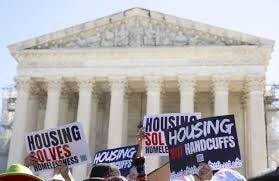
City of Grants Pass v. Johnson changed the constitutional landscape. The Supreme Court held that generally applicable public-camping ordinances did not violate the Eighth Amendment merely because they were enforced against homeless persons. The Court rejected the Ninth Circuit’s broad Martin/Grants Pass approach to the Cruel and Unusual Punishments Clause. 6
Grants Pass restored the basic distinction between status and conduct. Homelessness itself is not a crime. But conduct in public space - camping, obstruction, fire-setting, drug use, vandalism, theft, threats, biohazards, and nuisance - may be regulated by generally applicable law.
For Chico, however, Grants Pass did not automatically dissolve Warren. The City had entered a contract-like settlement without an adequate change-of-law reopener. This was a legal error, attributable to the City Attorney.
The City became trapped not by Martin alone, but by Warren. This is why Part One described the failed Rule 60 efforts as the transition from constitutional restraint to settlement captivity.
The City’s own July 2024 press release argued that Warren was premised on rejected Martin principles and had created a repeated cycle of noticing, cleanup, and reaccumulation.21
Policy rule: Post-Grants Pass policy should enforce to the minimum required procedure, preserve ordinary constitutional safeguards, and avoid transforming voluntary administrative practices into new legal entitlements.
VI. Housing First: Federal Funding Ideology and State Grant Architecture
For years, federal and state funding systems privileged Housing First as a mandatory policy premise for all federal and state funding for homeless services. California’s Housing First materials describe a model that seeks to connect anyone experiencing homelessness to permanent housing as quickly as possible while removing barriers such as sobriety requirements or the absence of a criminal history.10
California law and state programs adopted Housing First principles for specified homelessness programs, embedding the model into grant eligibility and program design.11
The policy problem is that Housing First became more than one tool. It became an ideology and a funding architecture. It treated housing as the primary answer even where the active drivers were addiction, mental illness, crime, service resistance, anti-social conduct, and refusal of rules. It also encouraged service systems to minimize preconditions, accountability, sobriety, treatment compliance, and conduct consequences.
The State Auditor reported that California allocated nearly $24 billion for homelessness and housing during fiscal years 2018-19 through 2022-23, while also criticizing the State’s inability to consistently track program costs and outcomes.12
Locally, the grant stream helped create a multi-million-dollar service ecosystem. The author estimates that more than $200 million has entered Butte County/Chico homeless-related systems since 2016.20
Funding created infrastructure. Infrastructure created constituencies. Constituencies created political pressure to preserve the system that funding built, altogether referred to as the Homeless Industrial Complex.
VII. HUD’s Reversal and the Collapse of the Expert-Consensus Shield
HUD’s recent reform announcements materially change the policy terrain. HUD announced that the 2026 Continuum of Care process would be reformed and rebalanced toward a diversity of solutions.13
HUD then described the housing-first experiment as a failure and emphasized recovery, treatment, and self-sufficiency.14 To quote from page 28 of that report:
“Housing First” has been a profound failure by any measure. Far from ending homelessness as promised, since the policy was first mandated by HUD in 2013:
• Literal homelessness (on the street, in emergency shelters, or in transitional housing) has increased 27%,
• Chronic homelessness has increased 80.5%, and
• Unsheltered homelessness has increased 36.1%.1
This is despite the fact that, since 2013:
• Taxpayer-funded “permanent housing” beds have increased 150.9%,
• “Rapid rehousing” was created, artificially lowering numbers by recategorizing people in short-term assistance as “permanently housed,” and
• CoC spending has increased 111%.”
This does not mean every Housing First program failed or that housing is irrelevant. It means the prior ideological monopoly has weakened. California can still fund services, but it can no longer claim as easily that state encroachment on municipal authority merely implements a settled federal expert consensus.
Policy rule: A failed statewide model cannot justify indefinite displacement of municipal authority over parks, sidewalks, plazas, waterways, nuisance, sanitation, fire safety, police deployment, and public access.
VIII. The City/State/Federal Homeless Industrial Complex
The combination of federal funding, state grants, county systems, local contracts, nonprofit service expansion, legal advocacy, shelter operations, outreach teams, harm-reduction services, housing navigation, and compliance bureaucracies created what this framework describes as the City/State/Federal Homeless Industrial Complex.
At the local level, that complex appears as the Homeless Industry: shelters, outreach providers, warming centers, food distribution, hygiene services, mobile services, storage programs, legal advocates, harm-reduction providers, consultants, coordinated-entry systems, and nonprofit contractors.
The existence of services is not itself the problem. The problem arises when the service system becomes unregulated, self-justifying, grant-dependent, locally consequential, and insulated from accountability for its spillover effects. If service providers attract, concentrate, protect, relocate, or stabilize encampments, then the City must regulate their capacity, function, location, and impacts.
Policy rule: Service providers must internalize local consequences. Compassionate activity does not carry a municipal-immunity halo.
IX. SB 634, Survival Services, and Municipal Affairs
SB 634 added Government Code section 53069.44, which restricts local jurisdictions from prohibiting persons or organizations from providing support services to homeless persons or assisting with acts related to basic survival.15
The Legislature also declared that ensuring a compassionate, evidence-based approach to ending homelessness is a statewide concern rather than a municipal affair, and therefore applies the law to charter cities.16
This is a legal maneuver with a familiar structure. A real broader problem is defined at a high level of abstraction, then used to reach local conduct. The analogy to Commerce Clause expansion is useful: the State identifies a statewide concern, generalizes it, and then incrementally displaces local control over concrete local consequences.
The better charter-city response is not to deny that homelessness has statewide dimensions. The better response is to narrow the issue: homelessness may be statewide, but parks, sidewalks, plazas, waterways, public access, nuisance abatement, sanitation, fire safety, and police deployment are municipal.17
Policy rule: The City should not ban survival assistance. It should regulate the secondary impacts of organized service activity by neutral time, place, manner, sanitation, fire, nuisance, obstruction, and public-access standards.
X. Status, Conduct, and the CEA Framework
The Contact, Enforcement, Accountability framework supplies the operational structure for post-Warren policy. The deck distinguishes condition/status from conduct. Homelessness, mental illness, drug addiction, and alcoholism are not crimes as statuses. But drug use, disorderly conduct, shoplifting, bike theft, illegal camping, vandalism, and similar conduct threaten public safety and quality of life.19
The framework’s sequence is simple: Contact, Enforcement, Accountability. Contact should be meaningful, directional, integrated, and coordinated. Enforcement should be consistent, inevitable, and consequential. Accountability should include self, family, community, and society.19
Status receives contact. Conduct receives enforcement. Repeated harmful conduct receives accountability through predictable and inevitable consequences.
This distinction is the moral and legal center of the post-Warren framework. It rejects criminalizing homelessness, but also rejects the idea that homelessness immunizes conduct. It allows the City to offer contact and referral without surrendering public order.
XI. Moral Framework: Against Suicidal Empathy and Toxic Compassion
The legal framework must be joined to a moral framework. The dominant homelessness ideology often treats enforcement as cruelty and non-enforcement as compassion. That is false. Compassion without boundaries can become destructive. Services without accountability can become dependency management. Harm reduction without recovery can become surrender. Tolerance of disorder imposed on the innocent is not mercy.
This framework uses two terms to name the failure: suicidal empathy and toxic compassion. Suicidal empathy sacrifices the civic body to avoid imposing necessary consequences. Toxic compassion protects destructive conduct because the actor belongs to a category treated as morally exempt.
A city has moral duties to unhoused persons. But it also has duties to children, families, elderly residents, disabled pedestrians, merchants, workers, park users, taxpayers, neighborhoods, and the civic inheritance itself.
Chico’s own municipal vision describes the City as “a safe place to raise a family, an ideal place for business, and a premier place to live.”18
Policy rule: Compassion must be ordered by reality and social norms. Public order is not the opposite of compassion; it is the condition that allows compassion to remain humane, lawful, and sustainable.
XII. Legal and Policy Conclusions for Part Three
Part Two produces the legal framework for Part Three. The City must now rebuild policy around the following conclusions:
· W&I section 17000 assigns indigent-care duties to counties and cities and counties, not ordinary municipalities.
Lavan requires a lawful property-handling process, not tolerance of unlawful public-space occupation.
Martin created shelter-availability pressure that migrated social-service burdens into municipal enforcement.
Warren converted that pressure into a five-year local settlement regime.
Grants Pass restored the status/conduct distinction and rejected the broad Eighth Amendment theory that drove Martin/Johnson.
HUD’s retreat from the Housing First monopoly weakens the claim that state encroachment merely implements federal expert consensus.
SB 634 and similar statutes should be contested at the boundary between protected aid and municipal regulation of local impacts.
The local Homeless Industry must be regulated by capacity, function, location, and spillover effects.
The City should extract itself from open-ended funding obligations for social services and return funding priority to municipal functions.
The post-Warren framework should enforce at the edge of legality: minimum legally required procedure, maximum clarity, documentation, and equal application.
Final Part Two formulation: Chico must not confuse compassion with surrender, services with governance, or statewide concern with statewide control over local public spaces.
Appendix A: Core Legal and Policy Excerpts
A. Welfare and Institutions Code section 17000
“Every county and every city and county shall relieve and support” qualifying indigent persons. This language assigns the duty to counties and cities and counties, not ordinary municipalities such as Chico.
B. Lavan property principle
Lavan protects homeless persons from government seizure and summary destruction of unabandoned personal property. The lesson for Chico is property process, not camping immunity.
C. Martin’s enforcement principle
Martin limited criminal punishment for public sleeping/camping when no shelter or lawful alternative was available. The lesson is that destinationless enforcement created legal risk before Grants Pass.
D. Grants Pass correction
Grants Pass held that generally applicable public-camping ordinances did not violate the Eighth Amendment merely because they applied to homeless persons. The lesson is to regulate conduct, not status.
E. California Housing First model
California’s Housing First materials state that homelessness programs should connect people to permanent housing quickly and remove barriers such as sobriety or absence of a criminal history.
F. California spending and accountability
The California State Auditor reported nearly $24 billion allocated to homelessness and housing during fiscal years 2018-19 through 2022-23 and criticized weak outcome tracking.
G. HUD reform
HUD’s 2026 announcements state that homelessness funding will be rebalanced toward a broader range of solutions and that the housing-first experiment failed to produce promised results.
H. SB 634 and municipal affairs
SB 634/Government Code section 53069.44 protects support services and basic survival assistance, while the Legislature declares the subject a statewide concern rather than a municipal affair.
I. Chico municipal vision
Chico’s municipal vision is “A safe place to raise a family, an ideal place for business, and a premier place to live.”
Endnotes
1. W&I 17000 - California Welfare & Institutions Code section 17000 - provides that “Every county and every city and county shall relieve and support” qualifying indigent persons; the text does not impose that duty on ordinary municipalities. Source: Cal. Welf. & Inst. Code section 17000; Justia, California Codes, 2025. URL: https://law.justia.com/codes/california/code-wic/division-9/part-5/chapter-1/section-17000/
2. County provider of last resort - Western Center on Law & Poverty, Health Care Guide, Chapter 7, “Counties’ Legal Obligation to Provide Care to Low-Income People,” Apr. 2016 - describes W&I section 17000 as obligating counties to serve as provider of last resort for indigent Californians without other means of support. URL: https://wclp.org/wp-content/uploads/2016/04/WesternCenter_2016_HCGuide_Chapter7.pdf
3. Lavan - Lavan v. City of Los Angeles, 693 F.3d 1022 (9th Cir. 2012) - held that the Fourth and Fourteenth Amendments protect homeless persons from government seizure and summary destruction of unabandoned personal property. Source: Ninth Circuit opinion, Sept. 5, 2012. URL: https://cdn.ca9.uscourts.gov/datastore/opinions/2012/09/05/11-56253.pdf
4. Garcia - Garcia v. City of Los Angeles, 11 F.4th 1113 (9th Cir. 2021) - later Ninth Circuit property-handling case applying Lavan principles to seizure/destruction of publicly stored homeless property. Use as additional authority for inventory, storage, and reclaim protocols.
5. Martin - Martin v. City of Boise, 920 F.3d 584 (9th Cir. 2019) - Ninth Circuit decision limiting criminal enforcement of public sleeping/camping laws against homeless persons when no shelter or lawful alternative is practically available. Source: Ninth Circuit opinion, Apr. 1, 2019. URL: https://cdn.ca9.uscourts.gov/datastore/opinions/2019/04/01/15-35845.pdf
6. Grants Pass - City of Grants Pass v. Johnson, 603 U.S. ___ (2024) - Supreme Court held that generally applicable public-camping ordinances did not violate the Eighth Amendment Cruel and Unusual Punishments Clause merely because they applied to homeless persons. Source: Supreme Court opinion, June 28, 2024. URL: https://www.supremecourt.gov/opinions/23pdf/23-175_19m2.pdf
7. Warren settlement - Warren v. City of Chico Settlement Agreement, Jan. 2022 - created the local settlement architecture, including Genesis, alternative camping obligations, outreach/enforcement procedures, dispute resolution, and retained jurisdiction. Source: Settlement Agreement PDF via Civil Rights Litigation Clearinghouse. URL: https://clearinghouse-umich-production.s3.amazonaws.com/media/doc/153010.pdf
8. Warren FAQ - City of Chico, Warren Settlement FAQ - describes enforcement-notice procedures, retained settlement framework, and the City’s public explanation of obligations under the Warren Settlement Agreement. URL: https://chicoca.gov/documents/City-Services/Sheltering-Provisions/Outreach-and-Engagement-for-Homeless-Individuals/warren_settlement_faq_final_1.pdf
9. Alternative sites - City staff report, Alternative Camping Sites, June 7, 2022 - states that if an individual is ineligible for Genesis/Pallet Shelter or Torres Shelter, the City must provide three alternative property locations where anti-camping ordinances will not be enforced for at least sixty days. URL: https://chico-ca.granicus.com/MetaViewer.php?clip_id=1069&meta_id=81595&view_id=2
10. California Housing First - California Department of Housing and Community Development, Housing First Fact Sheet - states that Housing First seeks to connect anyone experiencing homelessness to permanent housing as quickly as possible and remove barriers such as sobriety or absence of criminal history. URL: https://www.hcd.ca.gov/grants-funding/active-funding/docs/housing-first-fact-sheet.pdf
11. Housing First in California law - California Welfare & Institutions Code section 8255 and related provisions codify Housing First principles for specified state programs. Source should be supplemented in final legal appendix with official Legislative Information text for section 8255.
12. California State Auditor - “Homelessness in California: The State Must Do More to Assess the Cost-Effectiveness of Its Homelessness Programs,” Report 2023-102.1, Apr. 2024 - states that California allocated nearly $24 billion to homelessness and housing programs during fiscal years 2018-19 through 2022-23, and criticizes weak outcome tracking. URL: https://information.auditor.ca.gov/reports/2023-102.1/index.html
13. HUD reform announcement - U.S. Department of Housing and Urban Development, HUD No. 26-031, “HUD Moving Forward on Bold Homelessness Reform” - announces HUD intent to reform 2026 Continuum of Care funding and rebalance toward a diversity of solutions. URL: https://www.hud.gov/news/hud-no-26-031
14. HUD CoC NOFO / Housing First critique - U.S. Department of Housing and Urban Development, HUD No. 26-038, “HUD Overhauls Federal Homelessness Assistance,” May/June 2026 - quotes HUD Secretary Scott Turner stating that the housing-first experiment failed and that HUD is putting recovery first. URL: https://www.hud.gov/news/hud-no-26-038. Report: https://files.simpler.grants.gov/opportunities/18c6dc79-e5dd-42e9-aca5-b35c5d26eded/attachments/0ead4b33-e9a1-4934-92b3-65ed41847905/Foa_Content_of_CPD-2600-DC-0025.pdf
15. SB 634 / Government Code section 53069.44 - prohibits local jurisdictions from adopting or enforcing ordinances that prohibit a person or organization from providing support services to a homeless person or assisting with acts related to basic survival. Source: Cal. Gov. Code section 53069.44, added by Stats. 2025, Ch. 521, Sec. 2 (SB 634), effective Jan. 1, 2026. URL: https://law.justia.com/codes/california/code-gov/title-5/division-2/part-1/chapter-1/article-4/section-53069-44/
16. SB 634 statewide-concern finding - SB 634 legislative text, Sec. 3 - declares that ensuring a compassionate, evidence-based approach to ending homelessness is a statewide concern rather than a municipal affair and applies to charter cities. URL: https://legiscan.com/CA/text/SB634/id/3272904
17. Municipal-affairs doctrine - California Constitution, art. XI, section 5, and charter-city case law distinguish municipal affairs from statewide concerns; courts, not the Legislature alone, ultimately decide whether a matter is municipal or statewide and whether the state law is reasonably related/narrowly tailored. Final legal appendix should include California Fed. Savings & Loan Assn. v. City of Los Angeles, State Building & Construction Trades Council v. City of Vista, and related authority.
18. Chico municipal vision - Chico Municipal Code section 1.14.020(D) - states the City’s vision: “A safe place to raise a family, an ideal place for business, and a premier place to live,” and relates that vision to safety, cleanliness, beauty, and economic vitality. URL: https://codelibrary.amlegal.com/codes/chico/latest/chico_ca/0-0-0-706
19. CEA Deck - Contact, Enforcement, Accountability, Chico First policy presentation - distinguishes condition/status from conduct; states that homelessness, mental illness, addiction, and alcoholism are not crimes as statuses; identifies conduct such as drug use, disorderly conduct, shoplifting, bike theft, illegal camping, and vandalism as public-safety/quality-of-life concerns; and organizes response around Contact, Enforcement, and Accountability. Source: Uploaded file, Contact, Enforcement, Accountability.pdf.
20. Local funding estimate - Rob Berry estimates that more than $200 million has been injected into Butte County/Chico homeless-related services and grants based on estimating from an inventory of HHAP, ERF, ARPA, CDBG, ESG, behavioral-health, CoC, county, city, and nonprofit grants.
21. City of Chico press release - “Warren v. City of Chico and the SCOTUS opinion in Johnson v. Grants Pass,” July 17, 2024 - states Warren was premised on rejected Martin principles and describes the settlement as generating repeated noticing, cleanup, and reaccumulation cycles. URL: https://chicoca.gov/documents/City-of-Chico-Press-Release-Grants-Pass-07-17-2024.pdf
22. Post-Warren report - KRCR, Vincent Rupena, “Chico weighs Genesis shelter changes, expanded homeless enforcement after Warren deal ends,” May 22, 2026, updated May 25, 2026 - reports May 2026 post-Warren transition issues, Genesis costs/rules, closure of Eaton/Cohasset, and phased enforcement. URL: https://krcrtv.com/news/local/chico-weighs-genesis-shelter-changes-expanded-homeless-enforcement-after-warren-deal-ends